Showing posts with label photography. Show all posts
Showing posts with label photography. Show all posts
Thursday, November 22, 2018
Friday, July 6, 2018

Tuesday, July 3, 2018

Saturday, June 2, 2018

Friday, June 1, 2018

Wednesday, May 16, 2018
Saturday, April 21, 2018

Monday, February 19, 2018

Sunday, December 24, 2017

Saturday, December 16, 2017
The blog where form is given shelter and made beautiful

George Grantham Bain Collection, Library of Congress,
http://www.loc.gov/pictures/item/ggb2006006184/. Photoshopped.


Sunday, December 3, 2017

Friday, August 25, 2017
William Butler Yeats contemplates William Blake

Monday, August 11, 2014
My latest photochapbook, free to view and download,
is yours at the click of a mouse in the bookshelf at the bottom of this page. The title is Trophies and the contents amount to something like a meditation piece about the photography of history. If you want the keepsake edition on paper, the link will also get you to Peecho, a print-on-demand publisher.
Tell your friends, please!
Tell your friends, please!
Sunday, March 10, 2013
Sunday, October 21, 2012
Tuesday, July 31, 2012
From the history of gray
Paris, March 1839: Samuel F. B. Morse, in France to obtain European patents for his telegraph, attends a demonstration of Jacques Daguerre's new system for recording what has been seen. Taking note there of a gap in the record, he writes to a New York newspaper:
The headless, bodiless ghost that Morse saw in Daguerre's studio was probably this one.


Objects moving are not impressed. The Boulevard, so constantly filled with a moving throng of pedestrians and carriages was perfectly solitary, except an individual who was having his boots brushed. His feet were compelled, of course, to be stationary for some time, one being on the box of the boot black, and the other on the ground. Consequently his boots and legs were well defined, but he is without body or head, because these were in motion. (Taft 12)
---
The headless, bodiless ghost that Morse saw in Daguerre's studio was probably this one.

L. J. M. Daguerre, Boulevard du Temple, 1838 or 1839
Click to enlarge.
Just over a hundred years later, in America, another man fell under the influence of long exposure and went ghostly likewise.

Jack Delano, Street corner, Brockton, Mass., January 1941
Library of Congress, http://www.loc.gov/pictures/item/fsa1992000029/PP/
The grammar of Morse's 1839 description is beautifully precise. The feet of the shoeshine man's customer are described in the past tense because their moment of stasis is now only a historical fact, but the body and head remain in the historical present (as in "In 1865, Lincoln dies") because their invisibility now belongs to the category of the forever after (as in Secretary of State Seward's sentence after Lincoln's last breath: "Now he belongs to the ages"). As history, too, Morse's description approaches the fundamental. It reminds us that photography has erased every identifying mark of the shoeshine man and his customer and sunk them deep in a memory record which endures only as its elemental daguerreotype forms, copper and silver and mercury and gold.
Later in the process, Jack Delano was able to supplement Daguerre's monochrome mnemotechnic with color. To him it was given to see an image through to its end in Kodachrome, the crystalline and slow to fade. But the ghost in the margin of Delano's record is even less visible than the one in Daguerre's. In each of these two photographs with men in their corners, the process has failed to hold life still at the instant of its final pose.
---
In ways that Roland Barthes and Susan Sontag have discussed, Delano's photograph of a street corner is history inscribed in the genre of elegy. Once, not long before the approach of a photographer named Jack, a New England storm swept through Brockton, Massachusetts. For the moment and yet also approximately forever, a memory of the storm remains in white on a utility pole. There, seen as an image in a photograph, the white is a metonym for "winter" or "New England" which any American will know how to read. With the metonym's help, too, an archivist might be able to write (say) a history of snowplow routes in Brockton as of January 1941. But of course metonymy can't restore les neiges d'antan, or the way a winter day in Massachusetts would have made itself known to eye and flesh eleven months before Pearl Harbor, with so many of New England's soon to be dead still alive in their snow. In this image, snow reads its white to us, but its cloaking gray surround seems not yet to be readable, even after 71 years.
That color-coded signal warns the eye that Massachusetts's gray extends not just through its space but through its time as well.

Jack Delano, Near the waterfront, New Bedford, Mass., January 1941
Library of Congress, http://www.loc.gov/pictures/item/fsa1992000028/PP/
Yes, there's time in this picture. Those squat steel towers in their girdered cages were called gasometers, and few remain now in the United States. The smoke pollution may be due to return under a Republican administration, but for now it too is largely a thing of the past. And finally the image itself is depopulated of the people of 1941. As of 2012, what you see here of historic New Bedford is less a photograph in its own right than an architect's rendering of a not yet written history. It is a visual metonym for the past, camera-ready to be positioned on a page between paragraphs full of words about the past. Call your metonym something like "the gasometer era," and there's your symbol, right in the illustration. As an illustration, too, the symbol may be applied to any number of subjects.
But its grays don't cling to anything like a subject. Jack Delano, a documentarian with the Farm Security Administration, certainly had subjects in mind when he arranged to depict them, but even if he had considered gray to be a political quality (as in a pictorial equivalent of a phrase like "the grim gray of industrial New England"), he couldn't have taught it to make a political impression. In Jack Delano's New Bedford, gray is the unruly all-color that takes dominion because it defies classification by hue. Sunk below form in the color layer, a surround that decolors the image it encloses, the gray will be seen always to have been ghosting itself away from subject and composition and social order. If we could speak of a form in transit into the unsymbolizable, we might be able to name that thing "Gray" and speak of it as such. But it can't be spoken of as such. It is only the gray: a form that neither Samuel Morse nor we know how to say we didn't see.
---
Source of the passage by Samuel Morse: Robert Taft, Photography and the American Scene. 1938; New York: Dover Publications, 1964.
I am not related to Samuel Morse.
Saturday, April 7, 2012
Strike flat the thick rotundity o' the world
The fat man appears to be airborne over the ship's deck, hovering with arms stiffly extended forward and down like landing gear. His cushiony, shock-absorbing hands appear to be huge, but perhaps that's an illusion produced by foreshortening. In his image, outlined by a rectangular frame of decayed photographic emulsion, he is strongly foreshortened at every point.

At and around the man's hands, further decay has accentuated the contrast between the image's light and dark areas. The decay has done an artist's job: it has shaped an outline.
An outline is usually a line of demarcation which an artist lays down between his creation and the rest of the universe. Here, however, outline is an index of decay. The universe has invaded the physiology of this image like a virus and set it to manufacturing a counterfeit of the artist’s death-defying gesture of separation from time.
And the optics of photographic image-making have bloated the man into an incipient sphere: a fruit rounding as it ripens toward decay.
The rounding has been preserved in its incipience, however. It comes to us educationally, preserved through natural history as if it and we had been destined from the beginning to face each other from opposite sides of a vitrine.

Surrounded by the Library of Congress’s explanatory words, the image is a fat mute struldbrug surrounded by volubly signifying youthfulness. The words singing in the surround are a choir of still unravished brides.

"W. N. McMillan." G. G. Bain collection, Library of Congress. http://www.loc.gov/pictures/resource/ggbain.18560/
Click to enlarge.
At and around the man's hands, further decay has accentuated the contrast between the image's light and dark areas. The decay has done an artist's job: it has shaped an outline.
---
—
And the optics of photographic image-making have bloated the man into an incipient sphere: a fruit rounding as it ripens toward decay.
—
The rounding has been preserved in its incipience, however. It comes to us educationally, preserved through natural history as if it and we had been destined from the beginning to face each other from opposite sides of a vitrine.

Sunday, March 11, 2012
Chiral
All of us dwellers in the universe share the property of chirality, or handedness. It keeps us from ever becoming perfectly symmetrical. We can never again be simple unisex spheres, as we were (Aristophanes assures us) in the days before there was love.
About that interesting characteristic there's a new Issuu book on the wooden-looking shelf at the bottom of the screen. It's a free download.
For the intense yearning which each of them has towards the other does not appear to be the desire of lover’s intercourse, but of something else which the soul of either evidently desires and cannot tell, and of which she has only a dark and doubtful presentiment. Suppose Hephaestus, with his instruments, to come to the pair who are lying side, by side and to say to them, “What do you people want of one another?” they would be unable to explain. And suppose further, that when he saw their perplexity he said: “Do you desire to be wholly one; always day and night to be in one another’s company? for if this is what you desire, I am ready to melt you into one and let you grow together, so that being two you shall become one, and while you live a common life as if you were a single man, and after your death in the world below still be one departed soul instead of two — I ask whether this is what you lovingly desire, and whether you are satisfied to attain this?” — there is not a man of them who when he heard the proposal would deny or would not acknowledge that this meeting and melting into one another, this becoming one instead of two, was the very expression of his ancient need. And the reason is that human nature was originally one and we were a whole, and the desire and pursuit of the whole is called love.
-- Plato, Symposium, trans. Jowett
About that interesting characteristic there's a new Issuu book on the wooden-looking shelf at the bottom of the screen. It's a free download.
Thursday, February 10, 2011
Emily Dickinson, non-Spanish photographer
Better than most artists of the nineteenth century, Emily Dickinson understood the daring of surrender to somebody else’s way of seeing. When her correspondent Thomas Wentworth Higginson asked for her photograph, she replied:
Could you believe me -- without? I had no portrait, now, but am small, like the Wren, and my hair is bold, like the Chestnut Bur -- and my eyes, like the Sherry in the Glass, that the Guest leaves -- Would this do just as well?
In the era before color film, that must have done wonderfully. And Dickinson went on, generalizing and theorizing her refusal of dead representation in favor of the tints and pulses of life.
It often alarms Father -- He says Death might occur, and he has Molds of all the rest -- but has no Mold of me, but I noticed the Quick wore off those things, in a few days, and forestall the dishonor -- You will think no caprice of me -- (Letters, no. 268 [July 1862])
But in 2010, David Cody discovered something about this passage that must have disconcerted Thomas Wentworth Higginson. Dickinson's passage of self-description, with all its bright color and happy play, is in fact paraphrased, all but plagiarized, from the work of a novelist that Dickinson knew Higginson knew: Higginson's own protégée Harriet Prescott Spofford. For all we know, Dickinson may have meant the gesture as a bit of coy knowingness, a way of assuring a prominent man of letters that he could trust her not to embarrass him.
Trying to read at that level, we're disconcerted in a different way. Higginson may or may not have understood Dickinson's code of hints and allusions, but a century and a half later we can only read mute and open-mouthed in the unknowable anthropology of the dead. But we can't help reading according to other anthropologies as well -- for instance, the anthropology of Spanish photography that Gertrude Stein learned from Pablo Picasso.
Picasso at this period often used to say that Spaniards cannot recognise people from their photographs. So the photographers made two photographs, a man with a beard and a man smooth shaven and when the men left home to do their military service they sent one of these two types of photographs to their family and the family always found it very resembling. (14)
To the soldiers' artless families, a photograph wasn't a depiction; it was a representation by fiat. Because it was a photograph, it was taken to represent whatever it is that photographs represent. The families didn't think they needed to look at it; all that was required, they thought, was to know that it was a photograph and therefore just like every other photograph. For Picasso, the struggle was to break away from that categorical way of seeing and realize on canvas that (as Stein put it in a magnificent tautology), "One sees what one sees" (15).
With a photograph the learning can probably come easily; with a painting, an image that's more intimately a part of the artist's invisible secret self, it will probably come harder. But when the fiat representation is a corpus of words, communicating itself simultaneously in and through and as words . . . ?
Thomas Wentworth Higginson in 1862 wasn't the first person before whom Dickinson opened that abyss, either. As Marianne Noble discovered in 2000, one of Dickinson's most searingly passionate letters -- letter 93 from June 1852, the so-called "man of noon" letter to her future sister-in-law about the death-dealing joys of marital love -- is yet another paraphrase. It comes from one of the sentimental novels that the two 21-year-olds liked to share. They didn't need to articulate anything we might think of as personal, those two -- not when they had a Hallmark book handy to open the chocolate box of emotion for them. So when I read David Cody's article, it reopened a question that had been puzzling me for years: what in the world went wrong when Dickinson wrote letter 179, and could it be that it was one more fiction?
Written to Dickinson's friend Elizabeth Holland on March 18, 1855, this letter ostensibly describes the three weeks that Dickinson spent in Washington while her father was finishing his single term in the House of Representatives. I say "ostensibly" because in fact only a single paragraph is geographically specific below the level of a municipality's name (Washington, Springfield), and that paragraph --
well, here it is, in its entirety.
I will not tell you what I saw -- the elegance, the grandeur; you will not care to know the value of the diamonds my Lord and Lady wore, but if you haven't been to the sweet Mount Vernon, then I will tell you how on one soft spring day we glided down the Potomac in a painted boat, and jumped upon the shore -- how hand in hand we stole along up a tangled pathway till we reached the tomb of General George Washington, how we paused beside it, and no one spoke a word, then hand in hand, walked on again, not less wise or sad for that marble story; how we went within the door -- raised the latch he lifted when he last went home -– thank the Ones in Light that he's since passed in through a brighter wicket! Oh, I could spend a long day, if it did not weary you, telling of Mount Vernon -- and I will sometime if we live and meet again, and God grant we shall!
About this letter, Alfred Habegger's judgment is representative of the Dickinson specialists' consensus: "Making allowance for the simple tone she often took with the Hollands, it is dismaying to reflect that this unobserving and insipid prose issued from the pen of a great poet" (329). Yes, there are some familiar Dickinson tropes here, notably the withdrawal from communication disguised as an expression of solicitude ("if it did not weary you"). Betsy Erkkila has also read the paragraph as a political statement: "a version of national pastoral" (135). But what about the city, what about Mount Vernon? What about Emily Dickinson's language?
In Washington, most of Dickinson's walks, perhaps all, had been confined to the hallways of her hotel (Habegger 329). Within a year of the trip, her reclusiveness had become capable of inflicting traumatic distress.
http://jonathan-morse.blogspot.com/2010/06/pose-2-armor-x-ray.html
So (it occurred to me) what if Dickinson's Mount Vernon letter is unobserving because it's really a Spanish photograph? What if Emily didn't take the trip to Mount Vernon at all but remained in the hotel and then wrote her letter as a work of fiction, basing it on (say) a guidebook?
The hypothesis isn't provable, of course. It occurred to me many years ago, and I've never been able to do anything with it. Now, however, technology has caught up, and on a rainy Sunday afternoon I sat down in front of my computer, let myself into Google Books, and began reading Washington guidebooks from the 1850s. By the end of the afternoon, I'd laid my suspicion of Dickinson in 1855 to rest.
The history behind her letter turns out to have been simple. By 1855, Mount Vernon was dilapidated, with the summer house and slave quarters in ruins and the main building's piazza propped up with ships' masts. Inside, most of its rooms were empty, and one of them had had to be shut because tourists kept chipping pieces out of its marble fireplace. From the house, a rotting plank walkway led to the tomb of George and Martha Washington, but (then as now) that consisted only of a little brick mausoleum with the two sarcophagi visible through a locked iron gate. "The interior of this chamber is plastered, and the plaster is falling down in pieces," noted the English traveler William Ferguson (174). "Decay everywhere. It is festooned inside with hornet's nests, and swallows have also built in it abundantly. Placards are stuck up all round requesting visitors not to break the trees."
Amid the desolation, all an American tourist could do was wax patriotic, and this the contemporary American writers of guidebooks proceeded to do. "The garden is very large and seems in fine order," reported the New York Times's Minnie Myrtle, "but other parts of the grounds look sadly neglected." Having conceded the point, Minnie then gratefully changed the subject and concluded:
That Washington was perfect, I am not at all anxious to prove, but I wish to believe, and wish all the sons and daughters of America to believe, that he was free from every stain of immorality, as he certainly was.
But the British writers were less diplomatic. "By the end of half an hour," wrote William Ferguson at the end of a five-page tirade against slovenly slaves and a slovenly Mr. Washington, the current proprietor, "we were glad to be off. We came with veneration strongly excited. Disgust took its place; and we left, breathing hard words in reference to the present state of matters at Mount Vernon" (175).
And Emily Dickinson, travel writer? This evening, letter 179 looks to me like nothing more suspicious than a well-mannered attempt to say nice things about what must have been a disappointment. The great writer couldn't say anything more because there was nothing more to say.
But on a blog I can add one more thing: I couldn't have allayed my suspicion without Google Books. Without it, learning what I learned in a single afternoon would have cost me weeks or months of library and interlibrary work, and perhaps a special trip to the Library of Congress. Inside the new medium, however, I and some books were equalized in the part of the electromagnetic spectrum which is shared out between a computer's scanning range and a person's reading range. It's not that the sharing is a gesture in the direction of democratic reading; it's just that to a computer all data are equally part of a Spanish photograph, equally available to all forms of data processing. To the fastidiously withdrawn Emily Dickinson, however, they weren't. She did her best to fit her reading of Mount Vernon into Minnie Myrtle's American generic form, but she was too honest a viewer of the world ("One sees what one sees") to be able to succeed.
And as to her mysterious letters collaged out of other people's words -- without recourse to the idea of the Spanish photograph, they're even more mysterious. They play at being Minnie letters, but they don't play by any published rules yet discovered. They're one more reason to keep reading Dickinson, at any frequency the spectrum can offer. Thanks, Google!
Works Cited
Cody, David. "'When one's soul's at a white heat': Emily Dickinson and the 'Azarian School.'" Emily Dickinson Journal 19, no. 1 (2010): 30-59.
Dickinson, Emily. The Letters of Emily Dickinson, ed. Thomas H. Johnson and Theodora Ward. 3 vols. Cambridge, MA: Harvard University Press, 1958. Citation by letter number, not page number.
Erkkila, Betsy. "Dickinson and the Art of Politics." A Historical Guide to Emily Dickinson, ed. Vivian R. Pollak (New York: Oxford University Press, 2004), 133-74.
Ferguson, William. America by River and Rail; or, Notes by the Way on the New World and Its People. London: James Nisbet, 1856.
Habegger, Alfred. My Wars Are Laid Away in Books: The Life of Emily Dickinson. New York: Random House, 2001.
Myrtle, Minnie. "Traveling. A Day at Mount Vernon." New York Times 16 May 1855: n.p. Facsimile at
http://query.nytimes.com/mem/archive-free/pdf?res=9902E6DF103DE034BC4E52DFB366838E649FDE
Noble, Marianne. The Masochistic Pleasures of Sentimental Literature. Princeton: Princeton University Press, 2000. Cited in Habegger 277.
Stein, Gertrude. Picasso. 1938. New York: Dover, 1984.
Friday, August 13, 2010
On a scale of 1 to 10, pink
Our fantasies are conservative. They have to be, because they originate in the master fantasy of infancy: the fantasy that we and our world are unchanging. In infancy we aren't capable of thinking otherwise. Changing moment by moment, we live our way into the changing world, but all we know of our changing selves is what we were before the latest version of the world caught us up and changed us again.
Of course that way of knowing is irrational, and every once in a while some rational person tries to help us notice what we actually are. "Where id was, there shall ego be," said Sigmund Freud, and in 1957 the manufacturer of Lionel electric trains made a generous attempt to expand its market by liberating parents from the enslaving infantile fantasy of boy toys for boys, girl toys for girls. Lionel reset its injection molders to bring forth a girl train --
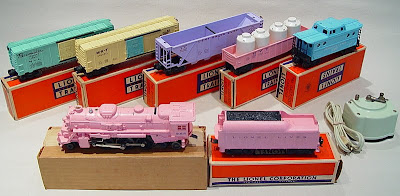
and comedy promptly undid the result. By girls and boys and fathers and mothers, unanimously, the Lady Lionel was laughed right into rarity. According to one collector, "There are stories of hardware stores actually painting these ugly pink trains black just to try to get part of their money back on them" (http://www.ibuyoldtrains.com/Lionel%201587s%20Pink%20Girls%20Train.htm). Comedy assures us that trains always have been black and always will be, and under the protection of that comforting promise we continue growing from unconsciousness into more unconsciousness.
The same oblivion was protecting adults in 1955 and 1956, when the Chrysler Corporation made its own effort to market a boy toy as if it could become a girl toy. The Dodge La Femme made its entrance in pink (for 1955) or lavender (for 1956), and in its first year it came accessorized with a matching pink purse, pink raincoat, and pink umbrella.


Of course the fashion didn't take. For women the pink remained on the car's surface, changing nothing because for most women a car has little presence in fantasy, where color works its infantile magic. For men, on the other hand, the pink penetrated into fantasy all too deep. Nineteen fifty-five wasn't only the year of La Femme; it was also the year of Rebel Without a Cause and The Shrike: a movie about a failed father who wears a frilly apron to wash the dishes, and a movie about a psychiatrist who liberates a failed husband by exorcising his wife with the magic word "castration." If the father of a one-car family were on his way to work in 1955, he wouldn't be driving a car marked with this bleeding stigma.

So La Femme is now a collector's item even rarer than the Lady Lionel train. Except under extraordinary circumstances, it is as vanished from consciousness now as last night's bad dream.
But now consider this even older image as it blazons its still living threat and promise across the page.

The image was seen in 1951 by Weegee, who added the title and the button some fifteen years later. According to Holland Cotter's article in the New York Times,
http://www.nytimes.com/2006/06/09/arts/design/09weeg.html
the photograph's factual history denotes only a couple waiting in line to attend a movie called Colt .45, and the picture of the weapon is nothing but a pass promising free admission to the entertainment. Nineteen fifty-one, we think when our eyes are closed and we're receptive to fantasy: a more innocent time, a happier time. History, sad dead grownup history, would only spoil the dream if it reminded us of what's called real life during the Truman-McCarthy era, three years before Brown v. Board of Education. History would make that sad story even sadder if it were to go still deeper into memory and remind us of what this particular boy toy was actually used for. And so, generally, we don't listen to history.
But Weegee looked at it. After a while he noticed that the color of this particular history was black, and that that color changed everything -- at least for the palette of the future's dreams. This particular artwork was never seen by a viewership until 2006: long after Weegee's own death, long after the slogan "Black power" itself had become history. Nevertheless, the blackness that Weegee saw is still with us. It floods the whole visual field, blurring the distinction between who in this fantasy picture is faceless boy and who is faceless girl. All that remains now of what they once were is the black: a single-color theme designed by the couturier Jude for what he called (in verse 13, King James version) "wandering stars, to whom is reserved the blackness of darkness forever."
"Forever": now there’s a collectible that will never go rare, turn pink, and disappear.
Of course that way of knowing is irrational, and every once in a while some rational person tries to help us notice what we actually are. "Where id was, there shall ego be," said Sigmund Freud, and in 1957 the manufacturer of Lionel electric trains made a generous attempt to expand its market by liberating parents from the enslaving infantile fantasy of boy toys for boys, girl toys for girls. Lionel reset its injection molders to bring forth a girl train --


and comedy promptly undid the result. By girls and boys and fathers and mothers, unanimously, the Lady Lionel was laughed right into rarity. According to one collector, "There are stories of hardware stores actually painting these ugly pink trains black just to try to get part of their money back on them" (http://www.ibuyoldtrains.com/Lionel%201587s%20Pink%20Girls%20Train.htm). Comedy assures us that trains always have been black and always will be, and under the protection of that comforting promise we continue growing from unconsciousness into more unconsciousness.
The same oblivion was protecting adults in 1955 and 1956, when the Chrysler Corporation made its own effort to market a boy toy as if it could become a girl toy. The Dodge La Femme made its entrance in pink (for 1955) or lavender (for 1956), and in its first year it came accessorized with a matching pink purse, pink raincoat, and pink umbrella.


Of course the fashion didn't take. For women the pink remained on the car's surface, changing nothing because for most women a car has little presence in fantasy, where color works its infantile magic. For men, on the other hand, the pink penetrated into fantasy all too deep. Nineteen fifty-five wasn't only the year of La Femme; it was also the year of Rebel Without a Cause and The Shrike: a movie about a failed father who wears a frilly apron to wash the dishes, and a movie about a psychiatrist who liberates a failed husband by exorcising his wife with the magic word "castration." If the father of a one-car family were on his way to work in 1955, he wouldn't be driving a car marked with this bleeding stigma.

So La Femme is now a collector's item even rarer than the Lady Lionel train. Except under extraordinary circumstances, it is as vanished from consciousness now as last night's bad dream.

But now consider this even older image as it blazons its still living threat and promise across the page.


The image was seen in 1951 by Weegee, who added the title and the button some fifteen years later. According to Holland Cotter's article in the New York Times,
http://www.nytimes.com/2006/06/09/arts/design/09weeg.html
the photograph's factual history denotes only a couple waiting in line to attend a movie called Colt .45, and the picture of the weapon is nothing but a pass promising free admission to the entertainment. Nineteen fifty-one, we think when our eyes are closed and we're receptive to fantasy: a more innocent time, a happier time. History, sad dead grownup history, would only spoil the dream if it reminded us of what's called real life during the Truman-McCarthy era, three years before Brown v. Board of Education. History would make that sad story even sadder if it were to go still deeper into memory and remind us of what this particular boy toy was actually used for. And so, generally, we don't listen to history.
But Weegee looked at it. After a while he noticed that the color of this particular history was black, and that that color changed everything -- at least for the palette of the future's dreams. This particular artwork was never seen by a viewership until 2006: long after Weegee's own death, long after the slogan "Black power" itself had become history. Nevertheless, the blackness that Weegee saw is still with us. It floods the whole visual field, blurring the distinction between who in this fantasy picture is faceless boy and who is faceless girl. All that remains now of what they once were is the black: a single-color theme designed by the couturier Jude for what he called (in verse 13, King James version) "wandering stars, to whom is reserved the blackness of darkness forever."
"Forever": now there’s a collectible that will never go rare, turn pink, and disappear.
Subscribe to:
Posts (Atom)